Midjourney Scanner: Can AI Hardware Save Your Life?
From generating astronaut cats to mapping your internal organs. David Holz's hardware pivot is the weirdest, most ambitious leap in tech history.
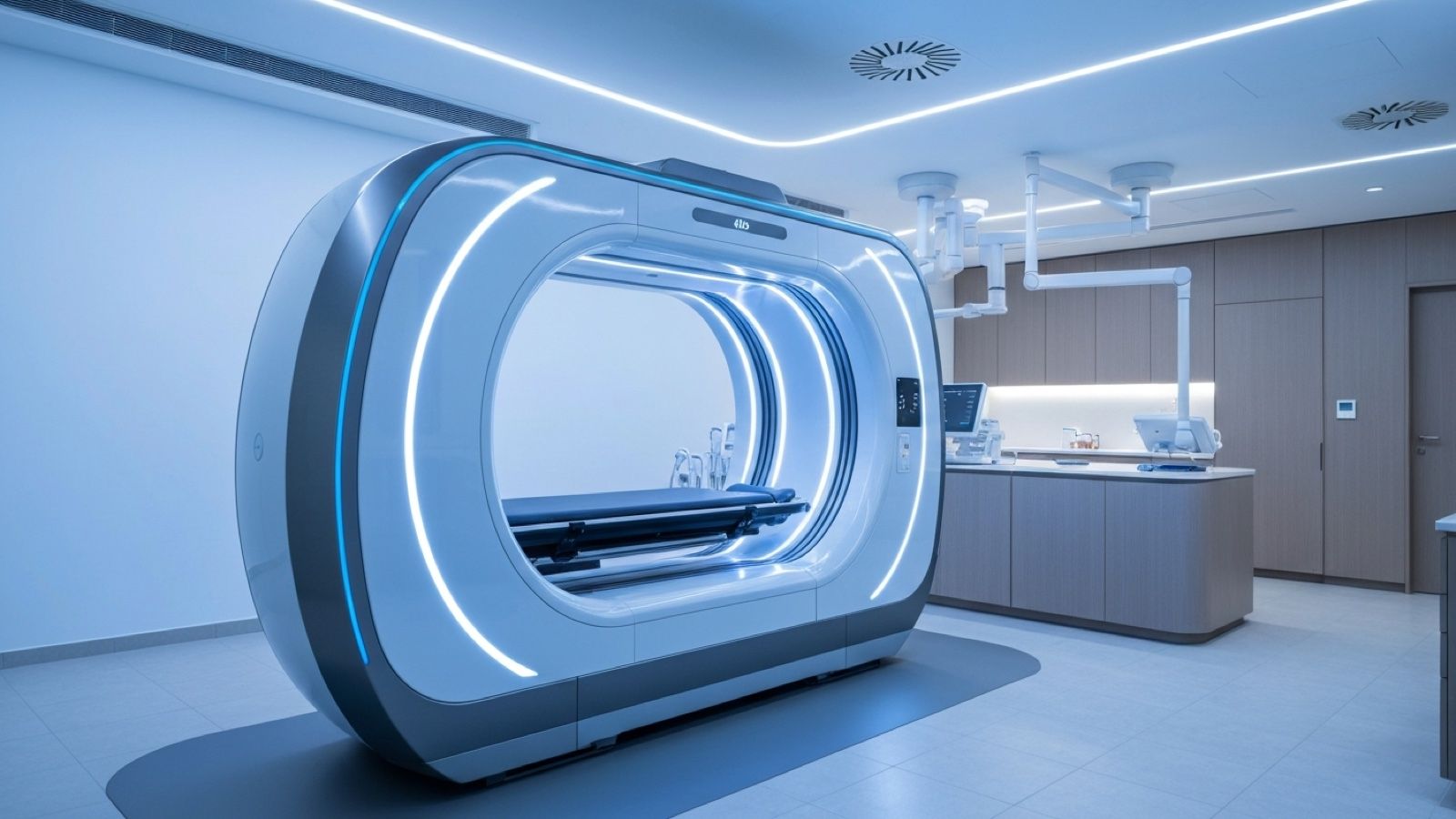
- Midjourney Medical is a new division focused on 'Ultrasonic CT' full-body scanning.
- The scanner uses 40 Butterfly Network ultrasound-on-chip modules to create 3D internal maps in 60 seconds.
- Users are partially submerged in water as a sensor ring scans at 5 centimeters per second.
- The device currently focuses on body composition to avoid the immediate need for FDA diagnostic clearance.
- Midjourney plans to open a flagship 'Spa' in San Francisco by late 2027.
The Midjourney Scanner is a full-body tomographic imaging device that uses ultrasound-on-chip technology to create detailed 3D maps of bone, muscle, fat, and organs in roughly 60 seconds. Developed by Midjourney Medical in partnership with Butterfly Network, it aims to provide MRI-quality internal data without the radiation of CT scans or the claustrophobia and magnets of an MRI.
The San Francisco event didn’t feel like a tech launch. It felt like a baptism. Midjourney founder David Holz stood before a crowd on June 17, 2026, and unveiled a machine that looks less like a computer and more like a high-end sensory deprivation tank. It is the first physical product from a company that built its empire on digital hallucination. They’re calling it the Midjourney Scanner, and it marks the official birth of Midjourney Medical.
For two years, the AI world whispered about a secret hardware project nicknamed the “Orb.” Most expected a VR headset or a prompt-capable camera. Instead, we got a full-body tomographic imaging machine that requires you to step into a shallow pool of water. It’s a sharp pivot from the Discord-based image generator that made Midjourney famous, but the technical DNA is more consistent than it looks. This is about data capture at a scale that makes your GPT-4 prompts look like finger painting.
What is the Midjourney Scanner?
The Midjourney Scanner is a full-body imaging system designed to replace the slow, expensive, and often terrifying experience of an MRI. While a traditional full-body MRI can take 90 minutes of motionless silence inside a vibrating tube, Midjourney’s “Ultrasonic CT” claims to do the job in 60 seconds. You stand on a platform. It lowers you into the water at five centimeters a second. You pass through a ring of sensors. You’re done.
According to official commentary from Butterfly Network, the prototype uses 40 of their proprietary Ultrasound-on-Chip modules. These aren’t traditional crystals; they are semiconductors that act as thousands of tiny microphones and speakers. When combined into the Scanner’s ring, they function like a dolphin’s echolocation, sending sound waves through the body from every angle to reconstruct a 3D map of your insides down to a fraction of a millimeter.
The Hardware Dream Team
This isn’t a hobbyist project. Midjourney spent the last three years poaching the best hardware minds in the valley. The division is led by Ahmad Abbas, an ex-Neuralink staffer who was a key engineer on the Apple Vision Pro. Abbas and Holz have a history that goes back to Leap Motion, where they tried to solve hand-tracking long before the world was ready for it.
By hiring the man who helped build Apple’s most complex spatial computer, Midjourney signaled that they weren’t interested in making a cheap peripheral. They wanted to build a device that processes terabytes of data per second. Unlike the discrete tasks performed by a standard what-is-an-ai-agent, the Scanner is a massive, integrated signal-processing beast. It uses two petaflops of on-device processing power to turn raw sound reflections into a coherent visual model of your organs.
The AI Paradox
Here is the twist: Midjourney says the scanner barely uses generative AI. At the launch, Holz was quoted by Bloomberg saying, “We’re not even using any AI in this yet—just really cool hardware and software.”
It sounds like a marketing backtrack, but it’s actually a regulatory chess move. By relying on pure signal processing and traditional reconstruction algorithms for the imaging, Midjourney avoids the “hallucination” problem that plagues generative models. They use AI for the segmentation—labeling which blob is your liver and which is your spleen—but the underlying pixels (or voxels) are grounded in hard physics. This is crucial for gaining eventual trust from a medical community that is understandably wary of “AI-enhanced” diagnostics.
The Spa Strategy
You won’t find this in a hospital—at least not yet. Midjourney is launching these scanners in “Midjourney Spa” locations. The first flagship is a 25,000-square-foot space planned for San Francisco’s Union Square in late 2027. It’s a lifestyle play. By surrounding the scanner with hot tubs, cold plunges, and saunas, Midjourney is attempting to decouple medical imaging from the dread of the doctor’s office.
This is also a clever way to bypass the FDA’s most stringent requirements. By marketing the device for “body composition mapping”—tracking muscle mass, bone density, and fat distribution—they can get the hardware into the wild immediately. Holz’s ten-year plan is to layer on clinical approvals until the machine can diagnose thousands of conditions, but for now, it’s a high-tech mirror for the biohacking crowd.
Why it Matters
The human stakes were made clear by tech evangelist Robert Scoble, who noted that a device like this might have caught the colon cancer that killed his best friend. Traditional healthcare is reactive; you get a scan when something hurts. Midjourney wants you to get a scan every week.
While we’re still debating if is-apple-intelligence-worth-it, Midjourney is moving past the phone and into the physical structure of our lives. They signed a licensing deal with Butterfly Network in late 2025, paying $15 million upfront and $10 million annually to secure the chip technology. That is the kind of cash you spend when you intend to build the 50,000 scanners Holz is promising.
The Verdict
Is it hype? Some of it. Midjourney has zero track record in physical manufacturing, and building a medical-grade device is infinitely harder than training a model on stolen JPEGs. The water-immersion requirement is a massive friction point for daily use.
But the sheer audacity of the move is refreshing. Most AI companies are content to build better chatbots. Midjourney is trying to build a window into the human body. If they can actually ship a 60-second, radiation-free full-body scan for the price of a gym membership, they won’t just be an AI company anymore. They’ll be an infrastructure company. And that is a much bigger game.
The other side of that professional-workflow coin is enhancement — my photographer’s-eye read on Magnific’s upscale-and-relight stack covers what happens after the image exists.
Bottom lineThe Midjourney Scanner is a breathtakingly high-stakes bet that people will trade a 60-second dip in a pool for total internal transparency. It’s too early to call it a medical revolution, but as a wellness product, it’s the most interesting piece of hardware since the Vision Pro.